The Solo Wholesaler's Ceiling
Most wholesalers hit the same wall. You're working leads, sending mail, taking calls, running numbers, writing contracts, and chasing buyers — all at the same time. You close a deal, then spend two weeks catching up on everything that piled up while you were focused on that one contract.
That's not a business. That's a job you created for yourself.
Scaling past 2–3 deals a month almost always requires two things working together: a virtual assistant (VA) to handle repeatable tasks, and a CRM to give both of you a shared, organized view of every deal in motion. Without the CRM, a VA creates confusion. Without a VA, the CRM just becomes another tool you're too busy to use.
This post is about getting both right.
Why a VA Alone Won't Save You
Hiring a VA sounds like the obvious fix. Offload the busywork, free up your time, do more deals. But most wholesalers who hire their first VA hit a wall within 60 days.
The reason is almost always the same: there's no system for the VA to plug into.
If your leads live in a spreadsheet, your follow-up notes are in your head, your buyer contacts are in your phone, and your deal status is tracked via text messages with yourself — a VA can't help you. They'll ask questions you don't have time to answer, make mistakes you don't have time to catch, and eventually both of you are more frustrated than before.
A VA multiplies what you already have. If what you have is chaos, you get more chaos.
What to Systematize Before You Hire
Before you post a job on Upwork or Onlinejobs.ph, audit your workflow. Every task a VA will touch needs a written process — even a rough one.
Here's a framework to work through:
1. Lead Intake
- Where do new leads come from? (mail responses, web forms, referrals)
- Who enters them into the CRM and what fields get filled in?
- What's the trigger to move a lead from "New" to "Contacted"?
2. Follow-Up Sequences
- How many times do you attempt contact before a lead goes cold?
- What's the cadence — day 1, day 3, day 7?
- What does your VA say or send at each touchpoint?
3. Deal Staging
- What needs to happen for a deal to move from Contacted → Under Contract → Assigned?
- Who is responsible for each stage?
- What does a "stalled" deal look like, and when does it escalate to you?
4. Buyer Outreach
- When a property goes under contract, who notifies the buyer list?
- What information goes in that message?
- How are buyer responses tracked?
If you can't answer these questions in writing, you're not ready to hire. Spend a week documenting your actual process — even if it's messy — before you bring anyone on.
The Right CRM Structure for VA Collaboration
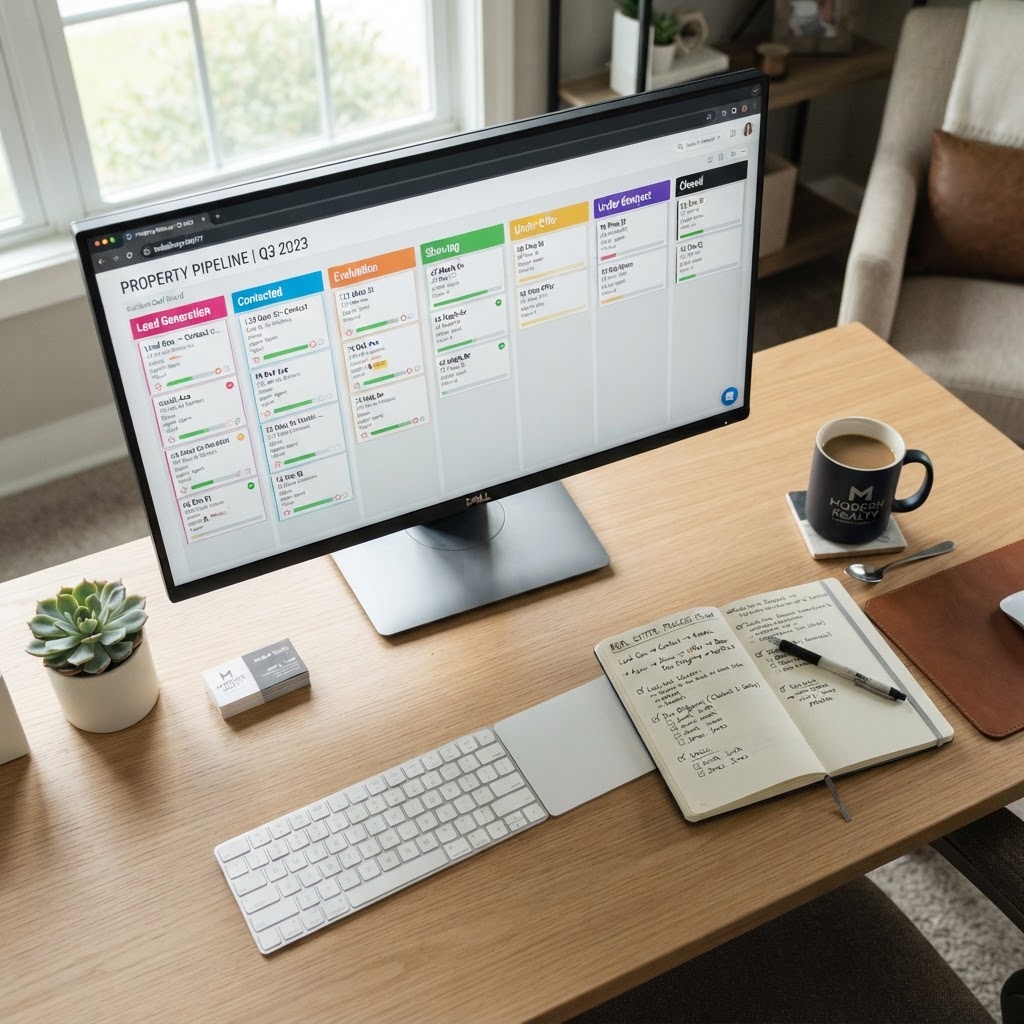
Once your process is documented, your CRM needs to reflect it. A kanban-style pipeline works best for wholesaling because it makes deal status visible at a glance — for you and your VA.
A solid wholesale pipeline moves deals through stages like:
New Lead → Contacted → Under Contract → Assigned → Closed → Dead
Every card in the pipeline should include:
- Seller name, phone, and property address
- Lead source (which mailer, which list, which channel)
- Last contact date and notes
- Next action with a due date
- Assigned team member (you or the VA)
When your VA opens the CRM each morning, they should be able to see exactly which leads need follow-up, which deals are waiting on documents, and which buyers need to be notified — without texting you a single question.
This is the kind of clarity that lets you actually step away and do high-value work: taking seller calls, negotiating deals, building lender relationships.
For a deeper look at how to structure your deal stages, check out how to manage your wholesale deal pipeline without losing leads.
What Tasks to Give Your VA First
Don't hand your VA everything on day one. Start with the lowest-risk, most repeatable tasks and expand from there as trust builds.
Week 1–2 (data and intake):
- Entering new leads into the pipeline from incoming mail responses or web forms
- Pulling basic property data and filling in deal cards
- Tagging and organizing leads by list type or campaign
Week 3–4 (follow-up):
- Sending follow-up emails or texts to leads in the Contacted stage (using pre-approved templates you've written)
- Logging every touchpoint in the CRM with notes
- Moving dead leads to the Dead stage and noting the reason
Month 2+ (disposition support):
- Blasting deal details to your buyer list when a property goes under contract
- Tracking buyer responses and updating the Buyer CRM
- Coordinating document collection for contracts and title
Notice what's not on this list: making offers, taking seller calls, or running ARV. Those stay with you. The goal is to strip away everything that doesn't require your judgment so you can focus on the conversations that close deals.
How PropWheel Supports a VA-Powered Operation
PropWheel's Pipeline module is built for exactly this kind of team workflow. Every deal lives on a kanban board with clear stages, and the built-in Buyer CRM means your VA can manage buyer outreach without jumping between tools. There's no spreadsheet handoff, no "who has the latest version" problem, and no deals falling through the cracks because a follow-up note lived in someone's personal inbox.
When a seller responds to a postcard — each one carrying a unique offer code tied to your Direct Mail campaign — that response comes in through Alex, PropWheel's inbound SMS assistant. Alex handles the initial qualification conversation: building rapport, gathering property details, and identifying motivated sellers worth your time. Your VA can then review qualified leads in the pipeline and prepare deal cards before you ever pick up the phone.
This separation of responsibilities is clean: Alex handles inbound seller conversations, your VA manages pipeline hygiene and buyer outreach, and you focus on offers and negotiations.
When it's time to make an offer, run your ARV on that specific property using the ARV/MAO Calculator — it pulls RentCast-powered comps and lets you adjust your MAO percentage for the deal. Don't burn your monthly lookup allowance on cold leads; save it for the warm ones that are ready for an offer. Once you're under contract, Contract Generation produces your PSA and Assignment agreement in seconds — another task your VA can initiate and track without pulling you in.
Building a Repeatable Disposition Process
Disposition — finding and closing with a buyer — is where most scaling attempts break down. You can generate more leads, but if you can't move properties fast once you're under contract, you're just creating a backlog.
A VA-assisted disposition process looks like this:
- Property goes Under Contract → VA creates a deal one-pager (address, ARV, asking price, estimated repairs, Deal Score)
- VA sends the one-pager to segmented buyer list (cash buyers who've bought similar properties in the area)
- VA logs every response in the Buyer CRM and flags serious inquiries
- You call the top 2–3 buyers and negotiate assignment fee
- VA coordinates scheduling for walkthroughs if needed
- Deal moves to Assigned, then Closed
For a strong buyer list to feed into this process, read how to build a cash buyers list from scratch.
The Real Payoff: You Show Up to Close, Not to Manage
The wholesalers doing 5, 10, 15 deals a month aren't smarter than you. They've built a machine where the repetitive work gets handled without their attention, and they show up to close deals.
A VA gives you capacity. A CRM gives your VA clarity. And a platform like PropWheel ties the whole workflow together — from lead intake to contract to close — without the duct tape of a dozen disconnected tools.
If you're still running your operation out of spreadsheets and sticky notes, the bottleneck isn't your market or your list. It's your system.
PropWheel starts at $75 for your first month, then $99/month. Start your first month and see what your pipeline looks like when it actually works.