Why Rehab Estimates Make or Break Your Wholesale Deal
You found a motivated seller. You ran your comps. You're feeling good about the ARV. Then you throw out a repair number — and your buyer laughs at you, or worse, closes the deal and never calls you again because the rehab ran twice what you estimated.
Rehab estimation is the skill most new wholesalers skip, and it costs them deals, credibility, and repeat buyers. You don't need to be a contractor to get this right. You need a repeatable framework that gets you close enough to make a confident offer — and close enough that your buyers trust the numbers you bring them.
This article breaks down that framework step by step.
The Real Cost of a Bad Repair Estimate
In wholesaling, your MAO (Maximum Allowable Offer) is only as good as your rehab number. The formula is straightforward:
MAO = (ARV × 0.70) − Estimated Repairs
If you underestimate repairs by $20,000, you overpay by $20,000. Your buyer either renegotiates, kills the deal, or takes the loss — and you lose a buyer relationship you spent months building.
If you overestimate repairs, you lowball the seller unnecessarily and lose deals you could have closed.
Getting rehab estimates dialed in isn't just about math. It's about building a reputation as a wholesaler who brings real deals — not garbage numbers dressed up to look like margins.
The Three Tiers of Rehab
Before you walk a property, understand that not all rehab is the same. Experienced investors mentally sort repairs into three buckets:
1. Cosmetic (Light Rehab)
These are surface-level updates. Think:
- Fresh paint (interior and exterior)
- New flooring (LVP, carpet)
- Light fixture and hardware swaps
- Landscaping cleanup
- New appliances
Rough range: $15,000–$35,000 for an average 3/2 in most markets.
2. Moderate Rehab
Cosmetic work plus systems and mechanicals:
- HVAC replacement or repair
- Water heater replacement
- Partial kitchen and bath remodel (cabinets, counters, fixtures)
- Roof patches or partial replacement
- Electrical panel updates
Rough range: $35,000–$70,000 depending on market and square footage.
3. Full Gut / Heavy Rehab
Everything above plus structural, foundation, or full systems overhaul:
- Foundation repair
- Full roof replacement
- Full kitchen and bath demo-and-rebuild
- Plumbing repipe
- Electrical rewire
- Mold or water damage remediation
Rough range: $70,000–$150,000+. These deals need to be priced accordingly, and your buyer pool narrows significantly.
Knowing which tier a property falls into before you run numbers keeps you from wasting time on deals that won't work at any price.
The Room-by-Room Walkthrough Method
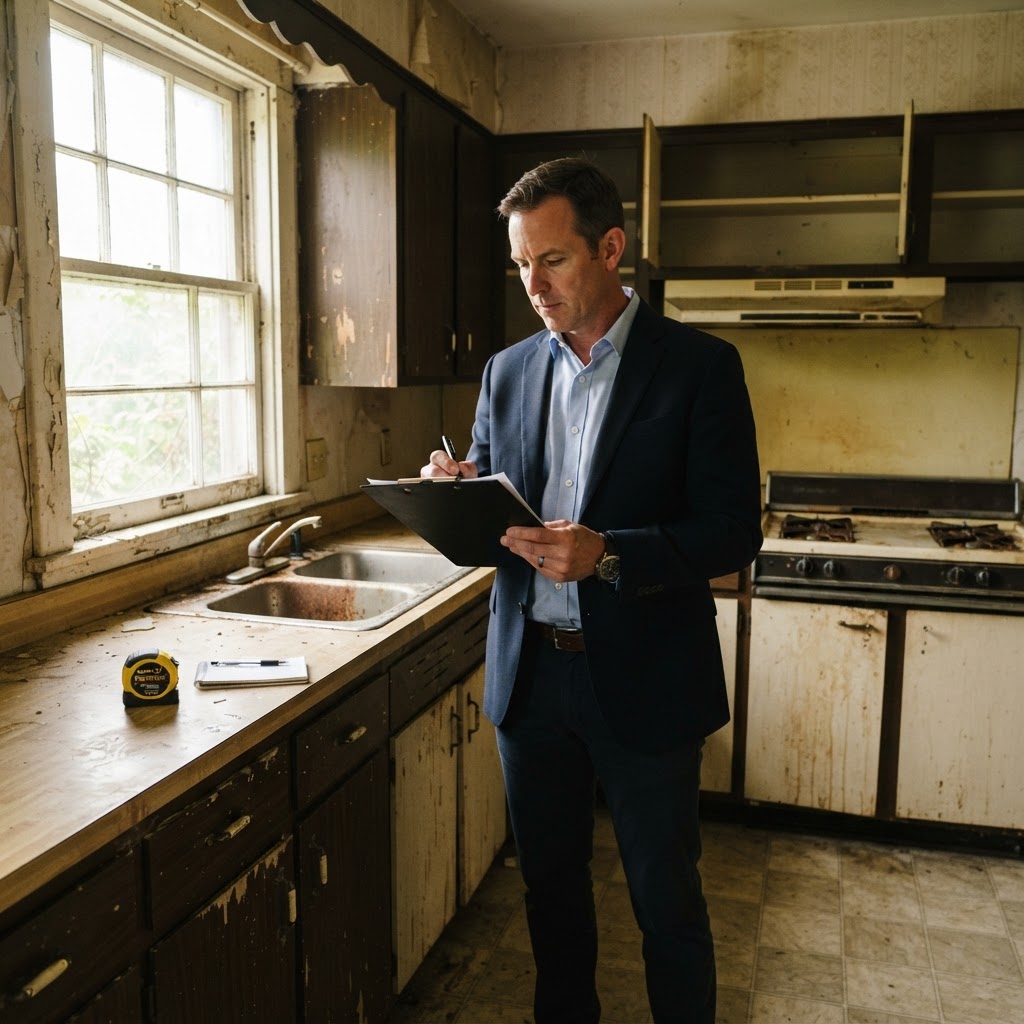
The most reliable way to estimate repairs without being a contractor is a systematic room-by-room approach. Bring a notepad (or your phone) and walk every room in order. You're looking for:
- Roof: Age, visible sagging, missing shingles, attic water stains
- Foundation: Cracks in walls or floors, doors that won't close, uneven floors
- HVAC: Age of unit, condition of ductwork, last service date
- Plumbing: Water pressure, visible leaks, galvanized vs. copper vs. PEX
- Electrical: Panel age and brand (knob-and-tube or aluminum wiring are flags), outlet types
- Kitchen: Cabinet condition, countertop, appliances, flooring
- Bathrooms: Tile, fixtures, subfloor condition around toilet base
- Floors: Type, condition, potential for refinish vs. replace
- Windows: Single vs. double pane, broken seals, operation
- Exterior: Siding condition, trim rot, driveway, fencing
For each item, note whether it needs: nothing, minor repair, moderate repair, or full replacement. Then assign a rough dollar value from your local market.
Building Your Local Price Sheet
Contractor costs vary significantly by market. A full bathroom remodel in Memphis looks nothing like one in Phoenix or Seattle. Your job is to build a local price sheet you update regularly. Talk to your buyers. Talk to contractors. Ask what they're paying per square foot for flooring installs, what a roof replacement runs per square, what a full HVAC swap costs in your area.
Keep a running document. Update it every quarter. This becomes one of your most valuable assets as a wholesaler.
Common Repair Line Items and Ballpark Ranges
These are national averages — verify in your market, but use them as a starting point:
| Item | Rough Range | |---|---| | Roof replacement (2,000 sq ft) | $8,000–$15,000 | | HVAC replacement | $5,000–$10,000 | | Water heater | $800–$1,500 | | Full kitchen remodel | $15,000–$35,000 | | Bathroom remodel (per bath) | $5,000–$15,000 | | Flooring (per sq ft, LVP) | $3–$6 installed | | Interior paint (per sq ft) | $1.50–$3 | | Foundation repair | $5,000–$30,000+ | | Electrical panel upgrade | $2,000–$5,000 | | Plumbing repipe | $4,000–$15,000 |
Always add a 10–15% contingency buffer on top of your estimate. Hidden damage — subfloor rot, mold behind walls, buried foundation issues — shows up more often than not once walls come open.
When to Use Your ARV/MAO Calculator
Once you have a repair estimate you're confident in, that's the right time to run your ARV and lock in your offer. PropWheel's ARV/MAO Calculator pulls RentCast-powered comps so you're not guessing at ARV from memory or stale data. Punch in your repair number, adjust your MAO percentage to match your buyer's expectations, and you've got a defensible offer in seconds.
The key word is warm lead. Don't burn your monthly comp lookups on cold lists you haven't touched. Run the calculator when you've got a seller on the line who's ready to talk numbers — that's when every lookup counts. If you want to understand the full MAO formula before you run your first calc, this breakdown of how to calculate MAO in wholesaling covers it in depth.
And don't ignore Deal Score when you're evaluating whether to push forward. The Rehab Certainty component (10 of 100 points) flags deals where your repair confidence is shaky. A low Rehab Certainty score is a signal to get a contractor walkthrough before you go under contract — not after. Learn how to read a wholesale deal score so you know exactly what each component is telling you.
Getting a Contractor to Walk the Property
For deals over a certain ARV threshold, or any property with potential structural issues, get a contractor in the door before you finalize your offer. Here's how to make that work in practice:
- Build relationships with 2–3 investor-friendly contractors in your market. These aren't custom home builders — they're rehabbers who work on investor flips regularly.
- Offer them first right of refusal on the rehab when your buyer purchases. Many contractors will walk properties for free if there's a realistic chance they get the job.
- Use your inspection period. Your PSA should include an inspection contingency. If a contractor walk reveals numbers that don't support your offer, you renegotiate or exit clean. PropWheel's Contract Generation module produces your PSA in seconds — make sure your inspection window is built in from day one.
For deals moving fast, your own room-by-room estimate plus a 15% buffer is often sufficient — especially if you've got a buyer who does their own walkthroughs before closing. The more deals you do, the sharper your eye gets.
The Disposition Side: Presenting Repair Estimates to Buyers
How you present your repair estimate matters as much as the number itself. Buyers who trust you will close faster and come back for more deals. Buyers who feel like you're hiding the ball will ghost you.
Best practice:
- Show your work. Send a line-item estimate, not just a single number. "$42,000 in repairs" means nothing. A breakdown showing $12,000 roof, $8,000 HVAC, $15,000 kitchen, $7,000 bathrooms — that's a professional presentation.
- Be upfront about uncertainty. If you couldn't get into the crawl space or the attic was inaccessible, say so. Your buyer will appreciate the honesty.
- Tie it back to the ARV and your offer price. Let the buyer see the full deal math. Transparent numbers build repeat business.
For more on building the buyer side of your business, see how to build a cash buyers list from scratch — because none of this matters if you don't have buyers ready to move.
Putting It All Together
Rehab estimation isn't glamorous. There's no shortcut that replaces walking properties, building a local price sheet, and doing the reps. But the wholesalers who get this right consistently — who bring buyers accurate numbers and defensible offers — are the ones who build real pipelines with repeat buyers and smooth closings.
PropWheel's ARV/MAO Calculator and Deal Score are built to support this process once you're on a warm lead. Run your comps when you're ready to make an offer. Let Rehab Certainty flag the deals that need a closer look. And use Contract Generation to lock up deals fast once the numbers work.
If you're ready to run your next deal through a system that takes you from lead to closed assignment without the spreadsheet chaos, PropWheel is built for exactly that.